u/MaggaraMarine
MaggaraMarine
MaggaraMarine
The first movement of Moonlight Sonata is actually great for practicing chords, because the entire movement is basically just arpeggios. I would recommend looking at the first movement from that perspective. You can already play it, but you can always learn more from the piece. And actually, being able to already play it makes studying what's going on in the piece easier.
MaggaraMarine
I'm talking about it being a half step higher than the major minor third.
Also, there is no minor 3rd against the root in the harmonic series. The first minor 3rd in the harmonic series is between the 3rd and 5th of a major chord. My point is, the E-G minor third is in the harmonic series of C.
This is actually why minor chords are difficult to "justify" from the perspective of the harmonic series. And this is also why some people have used the "undertone series" as a way of deriving the minor triad.
MaggaraMarine
Opiskellessa oppii uusia asioita. Tämä on itsessään ihan palkitsevaa, ja sitä kannattaa mielestäni ainakin pyrkiä arvostamaan. Etenkin sitten kun ei enää tarvitse opiskella, niin tällainen järjestelmällinen omien taitojen ja tietojen kehittäminen ja haastaminen helposti katoaa elämästä.
Nautitko opiskelemastasi alasta? Ovatko opinnot mielestäsi mielenkiintoisia?
MaggaraMarine
While it is true that using the 6th of the natural minor scale would affect the tonality, I don't think it would suddenly make the song that much sadder.
Wellerman is a good example of a song with a fairly similar feel, but it's fully in minor key (and uses the minor 6th degree).
The fact that you just chose another fifth keeps it pentatonic which is also not really minor
(Hexatonic if we are being 100% accurate, since the song uses the 2nd degree of the scale.) But it's not Dorian either. My point was that removing the major 6th doesn't affect the basic feel of the song that much. Your original claim I replied to was that the song sounds happier specifically because of the major 6th (that is what defines it as Dorian).
It does affect its tonality. But the "mood" of the song is more than its tonality. Of course the tonality affects it to a degree - if we use a more extreme example, playing it in the parallel major would clearly make it sound brighter.
Also, I like to define minor more broadly. If the tonic triad is minor, then it's in minor. Minor pentatonic, hexatonic, Dorian, Aeolian, etc. - those are all "different shades of minor".
Any way, here's how I would alter the melody of Drunken Sailor to make it fully Aeolian (IMO just changing the 6th from major to minor while 100% retaining the original melodic shape doesn't sound that natural):
What shall we do with the drunken sailor
A    A     A  A  A    Bb  A    D  F   A

What shall we do with the drunken sailor
G    G     G  G  G    A   G    C  E   G

What shall we do with the drunken sailor
A    A     A  A  A    Bb  A    A  C   D

Early in the morning
C  A  G  E   D   D
IMO doesn't change the mood that much.
MaggaraMarine
I disagree. The melody only uses the major 6th degree once (in the third "what shall we do with the drunken sailor"). You could easily alter the melody in a way that skips the 6th degree, and it wouldn't really change the basic feeling of the song.
For example try replacing the 6th degree with the 5th degree in the melody (in D):
What shall we do with the drunken sailor
A    A     A  A  A    A   A    A  C   D
Now there's nothing Dorian about the melody, but I don't think it's fundamentally different.
MaggaraMarine
The beginning of the progression uses fairly weak chord motion. Generally speaking functional progressions move down in 5ths and 3rds and up in 2nds. Your first half basically only moves up in 3rds, which doesn't create a clear sense of harmonic direction. Especially the move from vi to I is weak. You return to the tonic, but in a way that doesn't set up any kind of a resolution. (Of course you can also do stuff like this, and there are definitely songs out there that go from vi to I, but this progression is something that can easily sound aimless.)
So, it could be the progression that creates this feeling. But there are probably also other elements that create this feeling. With the right melody, the progression could sound just fine. Most likely, your melody also lacks a clear direction/structure. When writing melodies, it's often a good idea to try to base it on just a couple of different motifs. If you introduce too many ideas without developing any of them, the melody will pretty likely sound aimless.
Also pay attention to the melodic contour. Aimless melodies often simply noodle around using a couple of different notes, without creating a clear melodic shape/direction.
MaggaraMarine
"Common time" and "cut time" are both based on the old mensuration symbols.
There was also a mensuration symbol for triple meter that was a circle. In fact, the C in common/cut time is actually not a C - it's a half circle. This is because 3 is a "perfect number" and 2 is an "imperfect number".
A circle or a C with a dot meant the beats had 3 subdivisions.
So, basically
O = simple triple meter
C = simple duple meter
O with a dot = compound triple meter
C with a dot = compound duple meter
MaggaraMarine
anything in the actual physics or math of the intervals that makes major thirds and perfect fifths feel resolved and "bright" compared to minor
The notes in the major triad are in the harmonic series of a single note. Does this make major chords more inherently stable than minor chords? At least today, people have accepted them as equally stable. But in the renaissance period, pieces in minor modes ended in major chords (or alternatively in a chord with an omitted 3rd), so at least back then people did in fact consider the major triad as more stable than the minor triad.
The "brightness" probably simply comes from the fact that the major 3rd is higher than the minor 3rd. Another reason is that if you derive the 3rds by stacking 5ths, the major 3rd is 4 fifths in the sharp direction, while the minor 3rd is 3 fifths in the flat direction, so it's also "brighter" in that sense.
Now, neither of these necessarily makes people think major sounds happy, but I also don't think that association is completely arbitrary. BTW, in the past, people described major as "hard" and minor as "soft". An interesting video that talks about this. It's not explicitly about major vs minor. It's more about sharps vs flats. But as I pointed out, major harmonies are "sharper" than minor harmonies.
MaggaraMarine
Yes, there is definitely a similarity in style here. It's based on both hands playing an arpeggiated figure at the same time. The register is fairly similar, and the chord voicings are sort of similar too.
I don't hear a clear classical influence here. The chord voicings are just not classical-like.
I read that JVKE said Golden Hour was inspired by Franz Liszt, but after listening to a few of his pieces, I couldn't really find anything similar.
Yeah, if he was influenced by Liszt, then he hid his influence pretty well, because that doesn't sound like Liszt at all. I can maybe hear some influence from Liebestraum No.3. It uses arpeggios in a higher register and it's in a similar tempo and meter. But the chord voicings are pretty different.
MaggaraMarine
Last question, out of curiosity, if we go smaller, for example 32th, it keeps the two slashes, right?
No. If the speed of the tremolo is supposed to stay the same, then 32nd notes would get a single slash. Again, one beam = one slash, so if you add a beam, you remove a slash.
But also, since it's flutter tonguing, the "tremolo" here is an unmeasured one. Technically the notation implies it's supposed to be 64th notes, but in reality, it's not a precise rhythm. So, in this case being consistent with the speed of the tremolo isn't really that important. (I think it still looks cleaner if one slash is removed when one beam is added.)
But if it was a measured tremolo, then it would matter.
MaggaraMarine
Jos kannabikseen liittyvät väitetyt haitat olisivat niin suuria kuin on uskoteltu, niin silloin kolmannes suomalaisista työikäisistä kärsisi tällä hetkellä vakavista päihdeongelmista.
Tässä tilastossa näytettiin ihmiset, jotka ovat käyttäneet kannabista vähintään kerran elämänsä aikana - ei pelkästään niitä, jotka käyttävät kannabista aktiivisesti.
Varmaan joku ihminen väittää, että yksikin kannabiskokeilu johtaa pakosti vahvempiin aineisiin ja addiktioon, mutta onko tämä se argumentti, jonka ihmiset oikeasti ottavat tosissaan? Perustuvatko suurimman osan kannabiksen laillisuutta vastustavien argumentit tällaisiin väitteisiin, vai voisiko kyseessä olla enimmäkseen vain se, ettei uutta päihdettä haluta laillistaa (kun alkoholi on jo laillista), koska ajatellaan, että kannabiksen käyttö yleistyy sen laillistamisen jälkeen, jolloin sen negatiivisetkin vaikutukset yleistyvät?
Vastaavasti (verrattaen vaarattoman) huumeen käyttö ja ylinopeutta ajaminen eivät mitenkään mielekkäästi vertaudu toisiinsa.
Eivät vertaudukaan, mutta pointtina oli samanlainen logiikka argumentaation takana, ei rikosten vertautuvuus toisiinsa.
MaggaraMarine
It's not any more difficult than learning any other thing. There's plenty of logic behind music theory.
There are three main reasons to why people think it's difficult.
It's something people are forced to learn in music school, when they are mostly just interested in learning to play the instrument. In other words, they don't see much value in learning it, and their lack of learning motivation makes it feel difficult. (People generally do not learn things that they don't want to learn.)
People learn it too theoretically, not connecting it to musical practice. Most importantly, they don't learn the sounds of the theoretical concepts, which makes it feel disconnected from actual music. A lot of theory makes sense when you can actually hear how it works.
People don't know the right order of learning things (this is mostly an issue with self-taught musicians - but also, self-taught musicians are probably the ones who post most questions on this forum, because formally taught musicians can ask those questions from their teachers). They try to learn too much at once (without actually internalizing the basics), or they may try to learn too advanced stuff (again, without having internalized the basics). This has a lot to do with patience too. The most important thing about theory is actually how fast you can think, not how many concepts you know (in reality, the amount of knowledge you need for most music isn't that big). But people are more interested in knowing everything right now instead of focusing on internalizing the basics really well (and that naturally takes a lot of time). A related issue is that people try to learn the theory before they have basic playing skills on their instrument.
i learnt music theory for fun whilst learning how to play piano
This is the most important thing here. This made you naturally see the connection between the theoretical concepts and how they actually work in practice. Also, you obviously were motivated to learn because you described it as fun. Not everyone thinks learning theory is fun or interesting.
MaggaraMarine
D#m is F tier. I mean, who actually spells Ebm as D#m?
MaggaraMarine
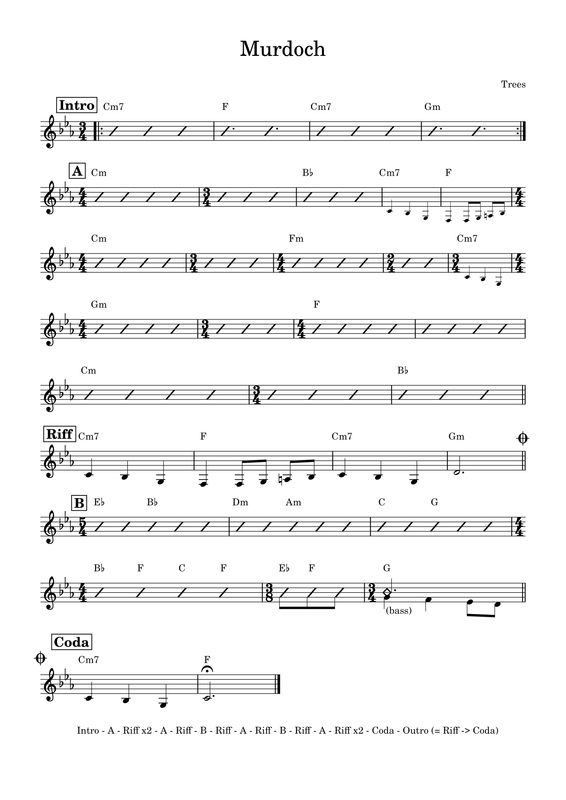
Here's a simple transcription with time signatures and chords.
MaggaraMarine
There is no single time signature.
The intro/main riff is in 3/4 (one bar per chord).
The verse is
[4/4 + 3/4] + 3/4 + 3/4 + 3/4
[4/4 + 3/4] + [4/4 + 2/4] + 3/4
[4/4 + 3/4] + [4/4 + 4/4]
[4/4 + 3/4] + 3/4
(The brackets represent harmonic rhythm. The bars inside the same brackets have the same chord.)
The chorus is mostly in 5/4 (2+3).
After three bars of 5/4, there's a single bar of 4/4, then a single bar of 3/8, and a single bar of 3/4.
MaggaraMarine
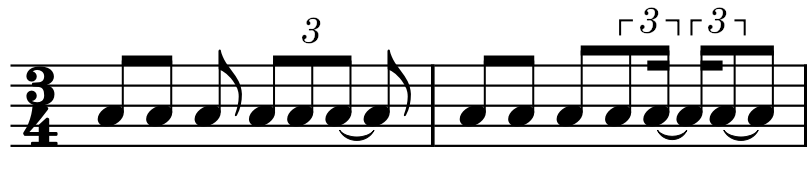
It's an offbeat triplet, notated in a way that makes the beats visible (so the middle note of the triplet is divided into two tied 16th notes). The "threes" apply to the second 8th note and the 16th note under the second beam group, and to the 16th and the next 8th note under the third beam group.
The rhythm would be clearer if it used triplet brackets instead of just the numbers.
Transcription. The first measure shows the "offbeat triplet" idea. The second measure shows the rhythm notated with the triplet brackets, making it a bit clearer.
Why are some notes written with three diagonal strokes and others with two?
When the note values are 8th notes, there are 3 slashes. When the note values are 16th notes, there are 2 slashes. Notice the extra beam in the 16th notes, which takes one slash away. If the rhythm used quarter notes, there would be 4 slashes. Basically, in "tremolo" notation, beam = slash.
MaggaraMarine
There is no polyrhythm here. It's just syncopated, with swung 16th notes.
Here's a transcription of the rhythm.
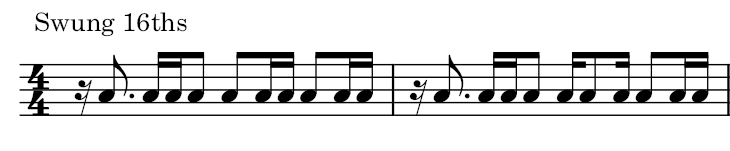
The confusing part is the rest on the downbeat, which could make feeling the downbeat a bit more difficult.
MaggaraMarine
Out of context, the chord could be Asus4, Dsus2 or E7sus4. (It could also be the upper structure of some extended chord.)
The name depends on the context.
MaggaraMarine
The melodies aren't really that close. It's the fact that they are in the same key and use similar instrumentation in similar register (simply put, a "similar vibe"). But if you actually listen to the notes, it is clearly a different piece of music.
MaggaraMarine
Your transcription doesn't have the correct notes.
The notes in the original melody are
C Bb C Eb
C Bb C Eb F C Bb
C Bb C Eb
C Bb C G F
All of those notes are in the C minor pentatonic scale.
The chord progression it's played over is Cm on the first time, and Ab Bb on the second time (the chord changes to Bb in the beginning of the 4th phrase).
A minor pentatonic melody over the i VI VII progression is really common.
Not sure if I have heard this exact melody anywhere else, though, but the basic elements it uses are fairly generic. Reminds me of the melodic/harmonic writing that's fairly typical in Iron Maiden's music (and also power metal more generally).
MaggaraMarine
If it constantly resolves to the "vi", then that "vi" is probably not actually the vi of a major key, but the i of a minor key. Basically, it's simply in a minor key (and not in a major key).
But remember that the music you most naturally come up with is most strongly influenced by the music you are most familiar with. This is simply the musical vocabulary/context you are most familiar with.
is this a me problem or does anyone else find minor keys way more satisfying to land on than major
It entirely depends on what the progression is doing. I don't find minor keys any more satisfying than major keys. If I hear an obvious major key harmony, then it most satisfyingly resolves to major. If I hear an obvious minor key harmony, then it most satisfyingly resolves to minor.
Doing the opposite wouldn't feel "satisfying", or if it did, then you would no longer actually be in minor if the major resolution felt more satisfying, or in major if the minor resolution felt more satisfying.
It all comes down to tonal center. If you are actually in A minor, then resolving to C major won't actually sound resolved. Similarly, if you are actually in C major, then resolving to A minor won't actually sound resolved.
MaggaraMarine
I don't hear an F# over that chord. It's just a C# over a C chord. (Time stamp to the relevant part.)
I would not include the melody note C# as a chord tone. It's C# played over a C power chord.
The melody is Aeolian, but the harmony is Phrygian.
MaggaraMarine
Unless you have absolute pitch, you probably won't hear a chord as "C major" or anything. You will only hear a major chord. Also, a single chord isn't in a key on its own. You need to hear more context to know how it functions. Sure, C major could be the III chord in A minor, but it could also be the V chord in F major/minor or the IV chord in G major, or the I chord in C major, or the VI chord in E minor or the VII chord in D minor. Or it could be a non-diatonic chord. You cannot know any of this without added context.
Are you saying that when you hear a major chord on its own, you naturally hear it as the III chord of a minor key?
Or are you saying that if you hear a major key chord progression like I IV V I, you naturally hear it as III VI VII III in minor?
Basically, what you are saying makes it sound like you are reading chord symbols and assuming it to be in a minor key instead of actually listening to what's going on.
MaggaraMarine
Half time happens in relation to something. For example in metal music, it's very common for the drums to change to half or double time. Basically, you start with kick on beats 1 and 3, and snare on beats 2 and 4. Then you change to kick on the downbeat and snare on the 3rd beat (half time), or kick on the beats and snare on the offbeats (double time).
Ride the Lightning by Metallica would be a good example of this. The main riff/beginning of the verse is in regular time (snare on 2 and 4). The "someone help me" section is in double time (snare on the offbeats). The beginning of the guitar solo is in half time (snare on 3).
Fast bpm means the main pulse of the song is fast. For example the tempo of American Idiot by Green Day is around 185 bpm. Compare this to Sad But True by Metallica where the tempo is a bit over 90 bpm. So, American Idiot is twice as fast as Sad But True. But this doesn't mean American Idiot is "in double time", or Sad But True is "in half time", because if you actually listen to the pulse, you will feel the main pulse as being 2x faster in American Idiot - the songs do not feel like they have the same pulse and only the drums have doubled (or halved) the beat. One is a slow/mid tempo song, and the other is a fast song.
As I said, half time and double time only really happen in relation to something.
"Half time" doesn't really apply to classical music in the same way that it applies to popular music, because the rhythmic accompaniment in classical music is often a bit more subtle, so a clear "half time feel" or "double time feel" doesn't apply to the same degree. (There are no drums that would change between "snare on 2 and 4" and "snare on the offbeats" or "snare on beat 3".)
But if by "half time" you mean "cut time" (the cut C time signature) or 2/2 time signature, then it simply comes down to how you want to notate the beats. The music could be notated with halved note values in 2/4 and it would also work just fine. The only difference is how it looks on page. Maybe the notation has a subconscious effect on the performance, but practically there is no difference between 2/2 with half note = 100 bpm, and 2/4 with quarter note = 100 bpm. Those are just two different ways of notating the same thing.
Some pieces are weird in this sense, though. For example the first movement of Moonlight Sonata is quite slow, but the time signature is still a cut C. But when you play it, you will still naturally feel quarter notes as the main pulse (unless you play it really fast, which just doesn't fit the character of the piece). There are also examples of pieces that are written in common time, but the pulse is so fast that nobody would actually feel it in 4 (basically, the time signature should be a cut C, because everyone actually feels it with a half note pulse).
fixed