u/RobIII
RobIII
RobIII
It doesn't know because it doesn't care. Switched mode power supplies (SMPS) regulate the output so they can (usually) take anything from 85V to 240V or maybe even a wider range. They then regulate down to the 5, 12, 20 or whatever volts you need. The components are selected so that they can handle the highest voltage from that input range.
Some older or cheaper power supplies usually have a physical switch (often red) that selects between 110 V and 230 V.
RobIII
No (useful) markings whatsoever on the PCB. C4003 REV isn't turning up anything useful.
I'm not sure this is a 433mhz receiver, but the long white wire does seem to indicate something of an antenna. And it seems to have programming dipswitches. Because of the lack of markings I'm assuming it's an original part of the GDO, not a 3rd party 'add-on'. If you can figure out a brand/type/model you might be able to find a manual or even remote.
RobIII
Incredible how you managed to still cover most of the important information .
RobIII
You're gonna have to post a clearer picture that's actually focussed onto something. Also a picture of the other side of the PCB would be (much more) helpful. Just be sure to not electrocute yourself while doing that (so unplug or switch off fuse). Posting the brand, model / type will also be very helpful.
RobIII
It would help if you mentioned the thing in the title or at least in the first few sentences.
The Goerz Metrawatt M2110 goes for around €100 to €250 on e-Bay. Something you could've looked up yourself pretty easily too. Is that value? Maybe, depends on how you define value.
RobIII
A decent, focused, well-lit closeup would be so much more helpful. As well as some more information on what we're looking at. I get that this is some HP device but an actual device type, model number etc. would be helpful as well. And to top it all off, some context would also be helpful: HOW did you overcurrent this USB port?
RobIII
This is a mechanical problem so not for /r/AskElectronics
RobIII
I can't help but wonder: this probably (also) has something to do with the precision of the calculations. Assuming doubles (and, for that matter, any other datatype) there's finite precision (and thus rounding upon rounding upon rounding... errors) in this simulation whereas in a (mathematically) perfect situation this would probably look very different.
RobIII
Google it says that the negative should be black not white
Even if Google said that, which I agree on with /u/1Davide is very unlikely, the picture is crystal clear in the manual? There's also clearly a - on the band. Just install it like in the picture? And it appears you did. So now you go over all components and check orientation / polarity and (solder)connections / bridges / shorts.
RobIII
Did you read?
I couldn’t describe something I felt motivated to make with these
It's pretty hard to just take some random bunch of IC's and make something from it. It usually works the other way around: you want to make something and pick the correct IC's for it.
RobIII
Why did you remove your question? Pretty disrespectful for the people taking time and making effort to help you answer your question to then delete it. Now your post is useless for everyone.
RobIII
I ve tried on google but found nothing
I don't buy that. First try from this picture :
74LS147N Project. The first hit is an explainer what it is and how to use.
Same for this picture:

74LS75N project. First hit has enough to get you started.
RobIII
Yes.
You could run any of those typenumbers through google (or ChatGPT or whatever) + "project" and see what they come up with.
RobIII
^ This.
I don't see anything that would "flip" an image; there's just a few passives and a voltage regulator on it. The video signal (yellow) is just a straight passthrough.
RobIII
Define "hurt". A big zap will hurt him probably, but it's unlikely to kill him. There's hunderds, thousands of volts but they lack the "oomph" (amps, current) to do any "real damage" (unless you stick it in your eye or he has a pacemaker or something...). It can also burn skin, trigger muscle spasms and I wouldn't recommend it across the chest, neck, or between both arms/hands or on wet skin either.
In short: It won't kill, but it may hurt like hell and if he keeps messing with it unsafely, under the "right" conditions, it might land him in the ER (but unlikely IMHO). But, hey, not once has a good warstory started with "I drank my milk and then...". We've all been zapped once or twice from worse things and most of us live to tell the tale.
RobIII
It would've been so much easier if you just posted the typenumbers instead of 4 (incorrectly oriented) over- or underexposed photo's.
From what I can make out, without overstretching my neck or trying to fix the photo's in photopea, there's some 74LS-something chips.
RobIII
I've been playing with it myself. This is what I got:
https://gist.github.com/RobThree/4869bfc3f023b63198bf08eaacff08f1
RobIII
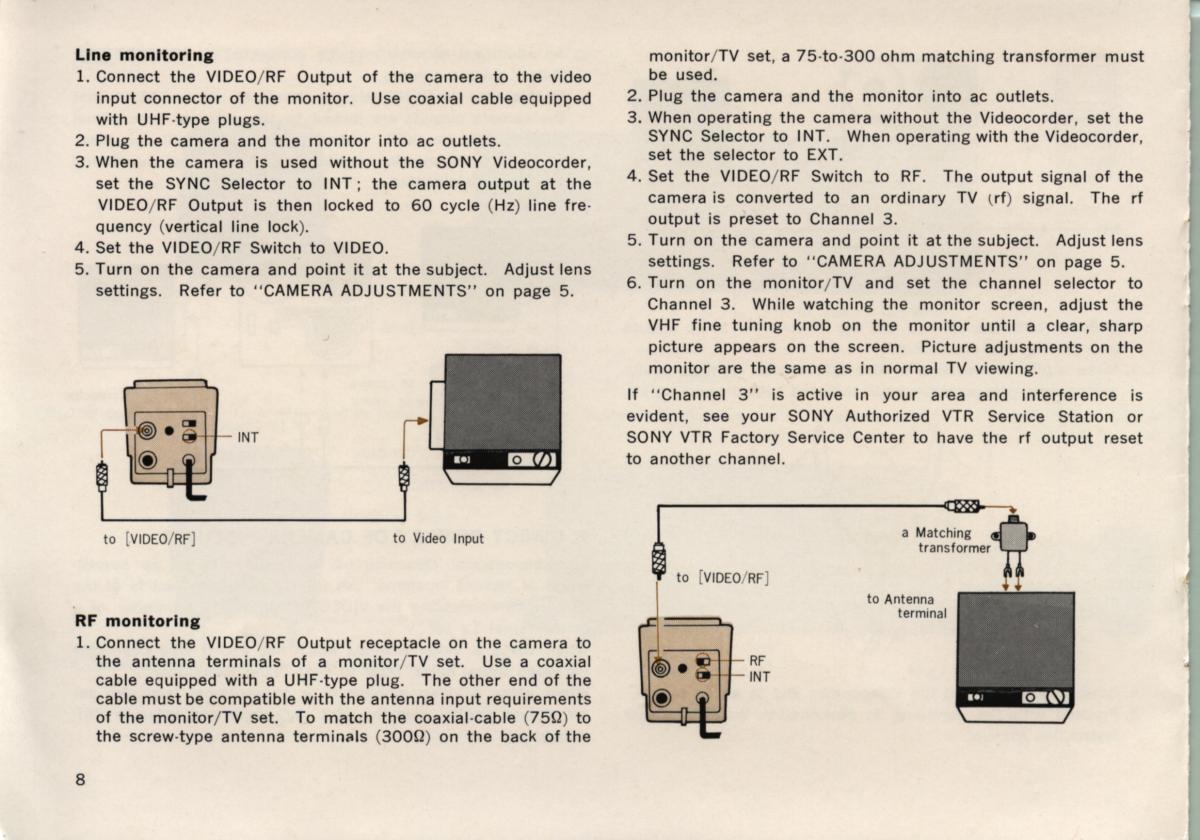
Use a coaxial cable equipped with a UHF type plug
- Source (here specifically).
Connect the Videocorder to the camera via the UHF coaxial cable
- Source
https://en.wikipedia.org/wiki/UHF_connector
PL-259, SO-239, PL-258
RobIII
For clarity: electrons don't have a single clue on what the color of the insulation material looks like when traveling through a conductor. They don't even have a clue what color is. They don't even have a clue for that matter. They don't think. So, yeah, color is only for us humans to tell functions of the wires apart.
RobIII
How can I do that?
From all that wealth of information and context you gave us, the links to the relevant products and datasheets, the schematics etc. I think the best answer we can give you is: Take out the mic, connect wires to mic contacts. Possibly add some passives like a resistor or capacitor 🤷♂️
RobIII
I've always thought it was on-off, but perhaps it has a built in auto-off after 8 hours?
Well, that would explain the excess of circuitry otherwise...
RobIII
Doesn't it contain some "auto off" circuitry? Or is it dimmable?
RobIII
Just stop using broken stuff. This is a fire hazard and possibly even an explosion hazard. Buy a new one or have this fixed by someone who knows what they're doing.
RobIII
Could you provide some more context? What are you planning to do with it? Or did you just find a random transistor and wondered how to use it? Also: this is easily found (Random BC337 datasheet). Why didn't that work for you?
Not OP but I use PartDB. For storage of most of my parts I have 6 Raaco C11-44 storage cabinets.