u/patchvonbraun
-
5points

patchvonbraun
patchvonbraun
That is, as they say "a simple matter of programming".
It's like arriving at GCC (the C/C++ compiler) and expecting that it's already, pretty-much, the application you would have written using GCC. Discovering that it's not, and being perplexed as to why the C compiler doesn't already implement the application you would have written with it.
Gnu Radio is an applications framework, for a specific class of applications. That class is very large. Very, very large. So it shouldn't come as a surprise then, that for a space that is nearly infinitely large, no finite effort can ever possibly address every single use-case "out of the box".
It's like arriving at a box of VLSI chips, and being perplexed, and not a little miffed, that they don't just sort of "self organize" into whatever it is you would have built with that box of VLSI chips. Some assembly required, which means, typically, some non-trivial skill in a number of relevant domains.
patchvonbraun
SDR transceivers are a niche product, as are designed-for-that-purpose SDR receivers.
If you're doing this as a business, then you have to be able to recover your engineering costs in the price you charge for your product.
Let's say you spend $1M developing a product (not unreasonable, considering that a functioning engineering company is going to need at least a hardware and software person, and other functions, and has to keep the lights on, the rent paid, etc, etc). You're not going to be in business for very long if you price a niche product such that it takes you 5 years to recoup the dev costs, particularly given that you'll need to be developing new products all the time. Development of the R820T and RTL2832U chips probably cost a whack of money. But they're targetted at a mass market--where you might sell thousands of units a day.
A lot of folks will say things like "it's just a bunch of chips on a board--how expensive could that be?". When the board is in your hands, it's typically the tip of a very wide/deep iceberg of a development cycle that might be two years long. Nobody can afford to do that for free....
patchvonbraun
Looks like we may be receiving our pulsar: B0329+54
http://www.ccera.ca/files/maybe_b0329+54.png

And then, on a subsequent observation the next day:

patchvonbraun
It's funny. I've seen them done that way years ago. Just was enamored of my friend Ken's 12-port design from the 1980s, so tried to replicate it.
But indeed a half-wave design such as you describe with the common port in the middle of the half-wave would work splendidly. Not sure why I didn't think of that.
My build is now "up in the air" and appears to be working spectacularly better than the consumer item it replaced. If I need to tweak, or for other projects, I'll remember the 1/2-lambda approach.
Cheers
patchvonbraun
It's only 1" pipe. Not quite room for a radial connector arrangement.
We'll see how it does. The commercial not-power-of-2 combiners necessarily have some amount of phase/amplitude imbalance inherently, because the hybrid "tree" isn't balanced.
patchvonbraun
Built a 6-port combiner/transformer for 611MHz:
http://www.ccera.ca/files/hexapus.jpg

This is for our pulsar antenna, which we're augmenting with a further 3 segments. A narrowband, 1/4-lambda combiner like this will be less lossy and have better phase balance than a consumer-type combiner.
My inspiration was from an amateur radio astronomy project back in the 1980s: www.ukaranet.org.uk/projects/IROHistory.pdf
patchvonbraun
Man, if each of those 14K subscribers could donate $5.00 to ccera.ca, we'd have enough funding for several years...
patchvonbraun
There's a guy in Italy using a 3d corner reflector designed for 408MHz that is successfully detecting B0329+54. That's the only target that an amateur stands any chance of detecting.
I'm using more bandwidth, and a more-stable clock. So, there's hope. We also might simply double the number of elements on the antenna, thus doubling the effective area. It's an experiment.
patchvonbraun
No, these are "as manufactured".
patchvonbraun
Yes, we're using in-line lightning arrestors where the cables come in through a common-grounded aluminum-sheet bulkhead into the lab.
patchvonbraun
Your books, and Alfred Morgan books. Inspirational for me in the 1970s!
patchvonbraun
Assembled one of two UHF interferometer antennae:

patchvonbraun
It's currently pointing at +40, and set up in transit mode. Might motorize it next year, with elevation sensor feedback. But for this winter, it will be boringly fixed at +40.
We mostly set up the 21cm dish and live data feed as a conversation piece and for something simple to teach students about this stuff.
patchvonbraun
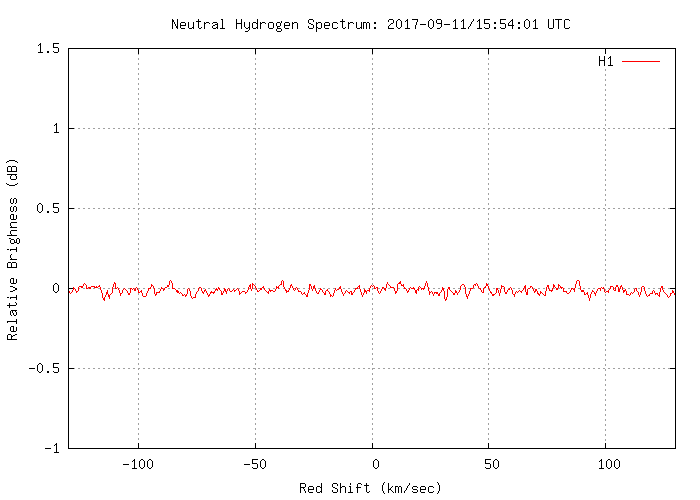
We have a every-3-minutes live feed from our 21cm radio telescope.
patchvonbraun
Two stages of TQP3M9037 eval boards, then a 21cm two-stage dielectric filter then an AirSpy mini in this case, but I use many different SDRs in radio astronomy.
patchvonbraun
Got some nice H1 spectra today:
http://www.ccera.ca/uncategorized/were-getting-hydrogen-spectra/
patchvonbraun
With a bit of help from some students, got the support frame for our initial 1m hydorgen-line radio telescope built. Needs to be painted before it goes up to the roof:

patchvonbraun
patchvonbraun
Highlight of the week so far:
patchvonbraun
When things reach a state where I'm ready to write a paper, I do so.
For example:
www.sbrac.org/files/budget_radio_telescope.pdf
and
patchvonbraun
Today's project:

http://www.ccera.ca/files/fully_fenced_array.jpg