u/silmeth
-
17points
-
5points

silmeth
silmeth
That’s really impressive amount of detail! What ISO is that, and did you use AI denoising?
(I don’t use any AI editing and noise can be an issue. But that’s true for any lens…)
silmeth
To be honest, I think most sharpness problems with this lens are not really stemming from the lens’s sharpness itself but rather things like:
- Motion blur – shutter shock can ruin the photo, try using electronic shutter and see if it helps; this lens doesn’t have stabilization and at tele-photo ranges the IBIS might not keep up at lower shutter speeds (but I’ve managed to get OK photos at ~1/80 s).
- Low light, high ISO – obviously if you don’t have enough light, the noise (and denoising) might cause loss of detail.
- Problems with AF – while the lens focuses OK, its AF motors aren’t as good as the ones in higher end lenses; I think some of my photos turned out soft just due to missed focus.
- Copy variation – I’ve heard there is a lot of variability in the quality of this model, but haven’t really tried other ones. Mine is decent and can produce pretty sharp results at 300 mm (at least in the middle of the frame).
At any rate, I’ve got some good results, even at the long end wide open, see eg. this robin photo. I pretty much never close this lens down. With a 20 MPx µ4/3 sensor you get diffraction limit at about f/6–f/7 anyway and closing the lens down will start hurting sharpness too.
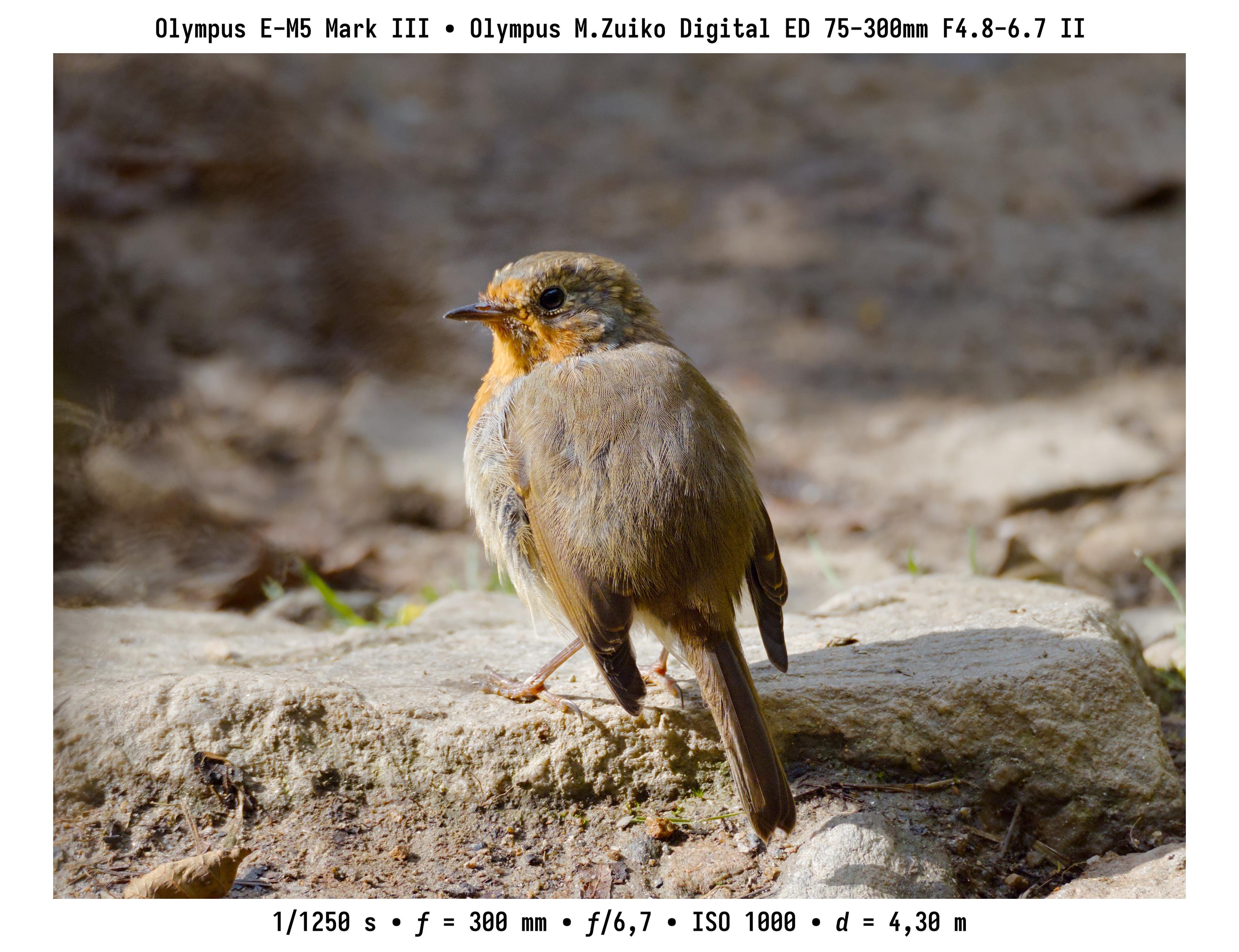
But often I’ll have a series of photos where ~30% of them are soft, presumably just due to my hand shake and the (otherwise excellent) E-M5 mk. III IBIS not keeping up. Or cause I use mechanical shutter for that particular shot and the shutter shock causing some blur at lower shutter speed (I had a few occasions when switching from mechanical to electronic shutter removed blur, at least at longer shutter speeds).
silmeth
Doesn’t sound Gaelic to me. If there’s underlying Gaelic text there, I don’t think it’s sung by an actual Gaelic speaker but I doubt there is (but bear in mind, my own audio comprehension in Gaelic isn’t that great so maybe others’ll have different luck). I don’t hear Irish either. The few seconds around 2:25–2:32 especially sounds Romance to me (maybe just clear high-front /i/ and the fact I hear syllables making the word Latina there makes me think of Latin and Italian…) if anything.
I can’t understand any of it or recognize the language (assuming that even is an actual spoken language).
silmeth
I’m not sure I have a good short list of resources.
The obvious place to start (but requires reading in Irish) is Anders Ahlqvist’s chapter about spelling (Litriú na Gaeilge ‘The Irish Spelling’) in Stair na Gaeilge (‘The History of the Irish Language’) edited by Kim McCone. In general this volume is IMO a must-have for any serious Gaelic historical linguistics.
I don’t know any other reference discussing the spelling and its history specifically though.
So I’d recommend grabbing an introduction to Old Irish (Stifter’s Sengoídelc as the textbook, Thurneysen’s A Grammar of Old Irish as the main reference, for slightly better discussion of spelling and phonology maybe McCone’s A First Old Irish Grammar and Reader).
For the general 15th–16th century Irish thought about spelling, digging directly into the 16th c. grammatical tracts, Eoin Mac Cárthaigh’s The Art of Bardic Poetry being a good modern edition with lots of notes and translation of the “introductory” tract which does discuss spelling a lot.
Then various scattered articles, especially by Mícheál Hoyne, about Classical Gaelic phonology. Also Custal Lewin’s article about the ao vowel in Gaelic dialects.
Also lots of information in McCone’s Towards a Relative Chronology of Ancient and Medieval Celtic Sound Change (but again, focus on phonological changes with spelling only used as evidence, not on evolution of the spelling).
And then for the oldest data (on phonology more than anything to do with later spelling) Damian McManus’ A Guide to Ogam.
But beside the chapter of Stair na Gaeilge I don’t know anything that would focus primarly on the history of the spelling itself.
silmeth
Well, the bardic tradition, while it lasted, was very rigid in the standardization of the grammar and poetic metres, and yet the spelling in manuscripts was all over the place (even though the tracts do comment on the spelling… and often don’t follow their own advice except in short examples illustrating them). So even with the standard and some authority supposed to enforce it, it wasn’t that successful. ;-)
Outside of the modern language generally spelling isn’t that rigid, and even in the 19th century I’d say Irish spelling stayed fairly consistent, for what it was. But yeah, I guess it’s fair to say that lack of any standardization after the fall of Gaelic order in Ireland some aspects of the spelling were getting standardized slower than they would had the old bardic education system survived.
As for the vowel, I wonder – but that’s me just speculating – if the bardic standard had some influence here. In strict dán díreach the áo(i) vowel did not rhyme with í or é, so in recitation also probably it was kept separate even in the regions that did merge it in the common speech (there are in fact examples of Connacht poems rhyming áo words with í words – written by an ollamh i seanchas ‘ollave in history/lore’ rather than by ollamh i bhfilidheacht ‘ollave in poetry’). Maybe some kind of prescriptivism against the vowel /iː/ in the fairly important culturally word Gáoidhilg led the dialects with áo ~ í merger to keep them apart in this word and merge it with /eː/ instead (which before a broad consonant is a regular treatment in the south). But this doesn’t explain the Scottish data at all, and I’ve no better idea.
EDIT: but áo ~ é fluctuation sometimes happened fairly early, eg. Classical Gaelic has both áon- and én- as a prefix meaning ‘one, single, only’. Apparently in Ulster craobh can be said as if craebh /kreːu/ too (but also /krɯː/). In Munster you get caora /kiːrə/ (and not expected */keːrə/) vs caorach /keːrəx/ (the expected outcome).
silmeth
Sorry, I actually messed that part up. It was mostly written as Gaedhilge – with ae working as you’d expect, with e being treated as a slender letter (e on the left, i on the right of dh).
The rest of the message (and the main point – the leathan le leathan rule is a modern invention, and post-caighdeán spelling has ae as a broad unit) still stands (and ae was mostly treated as broad-slender sequence earlier; though there are exceptions like aer, gen. aeir – spelt so in Dinneen’s dictionary – too, though sometimes aedhear or aidhéar, or aodhar – also variants listed in Dinneen’s – etc.).
I’ll edit the post above to rectify this.
silmeth
I’ll start with the second question, about spelling:
In the new spelling the digraph ae is considered broad. Compare aer (from classical aeidhear, from OIr. aër, aiër /a.ər/, a hiatus word; in Classical spelling the dh was used just to mark the hiatus or maybe a consonantal glide inserted there), also a newer formation, aeráid ‘climate’. In the Caighdeán Oifigiúil spelling the digraph ⟨ae⟩ is just a way to spell long /eː/ between two broad consonants.
There was no “leathan le leathan, caol le caol” rule in Classical Gaelic. This is a post-classical generalization of late classical (post-15th century) scribal practices. In pre-reform (but modern, not classical) spelling the language would be typically called Gaeidhilg EDIT: Gaedhilg (note aei ae fitting the leathan-leathan, caol-caol rule, slender e and i on both sides of dh) from Classical accusative-dative form Gáoidheilg (~ Gáoidhilg, Gaoidheilg, Gaedheilg, etc.).
The whole rule developed out of off-glides developing after vowels (and then changing the vowels’ qualities) during Middle Ages in Ireland. In the post-15th century spelling it was common to write ea for OIr. e before a broad consonant (eg. fear, bean) because by this time it was pronounced /a/ (/f´ar, b´an/) but still just é because it was still /eː/ (eg. sgél ‘story’, modern scéal).
As for the main question: what happened to the vowel – I honestly have no clue. I’m sure there are some articles out there discussing the developments but I haven’t found any (I wasn’t looking very actively though). I don’t think it’s explained in Stair na Gaeilge, at least I don’t remember any discussion of this.
I suspect for most dialects this is just a regular outcome of older disyllabic /əːɣ´ə/ (instead of /iː/ continuing -aoi- /əːC´/ in other contexts), but note Scottish Gaelic Gàidhlig being /ɡaːliɡ´/ while Gàidheal being /ɡɛː.əɫ/ – neither of which has the expected ao (/ɯː/) vowel.
silmeth
Living dialects of Irish, ie. those that are actually used as the default communication system in everyday situations in their communities and show intergenerational transmission, all still keep broad and slender consonant distinctions as well as distinctions between lenited and non-lenited stops.
And none of these varieties of the living language resemble what many urban speakers speak (but not all, as there hasn’t formed a single coherent urban dialect – as research into urban speakers show they differ a lot in the linguistic features, including phonology, some consistently distinguishing /k/ and /x/, some not doing that at all, etc.).
So yeah. You need to respect the variation within THE LIVING LANGUAGE.
But people whose first language is English who learn Irish and practice it in conversation circles and online are not a part of the community of the living language. This is a different sociolinguistic setting.
You could argue there are 1st language speakers of Urban Irish, there are people raising their children with it. I’ll argue that, since the community in which those children are raised is still predominantly English and those children grow up to be stronger English speakers, their L1 is still English and while they are proficient in (Urban) Irish, that’s a heritage language for them, not their native language.
And whether there is any sustained intergenerational transmission (ie. whether those Urban Irish-raised children actually keep and pass their variety on to next generations) remains to be shown.
silmeth
Its first sentence is this, though (capitalization original):
SCOTLAND could have no native speaking Gaelic communities “within this generation”, an expert in the language has warned.
It’s also published and hosted by a Scottish newspaper.
silmeth
No. Again you’re twisting my words to build a strawman you want to fight.
I’m saying I doubt that Urban Irish varieties will manage to establish themselves as community language(s) anywhere, due to social situation favouring English and lack of motivation for their actual use.
I’m also saying that I will not be personally interested in them. Doesn’t mean I’m saying they’re “unacceptable” or am against them. Those are your words, not mine.
If Urban Irish establishes itself as an actual first language of a community (rather than being limited to uses as an identity marker and a hobby in limited activist and researcher groups) it’ll be a community language like any other, and sociolinguistically extremely interesting one (but again, I doubt this will ever happen). It just won’t be of interest to me.
There are acceptable things out there in the world that do not interest me, however wide my interests are.
EDIT: but yes, I do disparage popularizing those varieties for as long as intergenerational transmission of Irish in the Gaeltacht exists and there are efforts to keep it. Because giving prestige to Urban Irish or neo-Irish or whatever you want to call it does contribute to the minoritization of the Gaeltacht speakers.
EDIT2: that does not mean I mind people learning Irish (again, I’m a learner too! I was teaching the language. I try to help other learners.). What I do oppose is prioritizing learners over native speakers in the media, allocation of resources, in language planning policy, etc.
silmeth
It’s a made-up “fact”. Not that dictionaries dictate what’s “correct” and “incorrect” but assuming that Oxford English Dictionary manages to describe actual usage in English, Gaelic as a noun refers to either:
Frequently with the. Any of the three Goidelic languages spoken in Ireland, Scotland, and the Isle of Man (or variations of these as spoken in diasporas, esp. in North America).
a. Scottish Gaelic.
(…)
2017 My parents insisted that only Gaelic was spoken in the house. (M. Rowe, Outer Hebrides (Bradt Travel Guides) ii. 54)
or, closer to the meaning on which you insist:
- The Goidelic (see Goidelic adj. A.2) languages spoken in Ireland, Scotland, and the Isle of Man regarded collectively as variants of a single language; the Celtic language from which these developed.
So Cambridge Dictionary:
Gaelic noun [U]
(also Scots Gaelic, Scottish Gaelic)
a Celtic language spoken in some parts of western Scotland
Sure, the parent commenter in this sub-thread could have written Scottish Gaelic to avoid any ambiguity (especially when contrasting it with the Gaeltacht areas… where different varieties of Gaelic are spoken) – but the context still is an article about the situation in Scotland which itself repeatedly uses the term Gaelic specifically in reference to Scottish Gaelic. And contrasting Irish and Gaelic (ie. Scottish Gaelic) isn’t uncommon either.
Also congratulations – you convinced me to finally downvote a comment of yours.
silmeth
And Hebrew was widely known – even if not a community language, it’s been the Jewish lingua franca for centuries, very much like Latin for most Europeans during later Middle Ages and the beginning of early modern era. When Hebrew revival was taking place most Jewish people would have pretty solid basics in Hebrew already, despite it not being their first or community language at that point.
silmeth
In the context of the article discussed (as also generally in context of Scotland) Gaelic very much is the (Gaelic) language spoken in Scotland. That’s exactly how the word Gaelic is used in the article too.
silmeth
here is nothing wrong with "Ah sure, it'll be grand"...it's a step on the journey. Just like a toddler who says "I goed to Nana's house" eventually realises it's "went", a learner will pick up from other people who model the right way.
Yes. You’re of course right. The problem with Irish though is that there is not enough exposure to actual good models who speak “the right way”. Learners, who don’t, outnumber the native speakers and many never talk to native speakers, don’t consume media produced by native speakers (Ros na Rún, listening to Raidió na Gaeltachta, reading native speaker writers…).
People are amazing at deducing complex patterns from exposure – but it requires a lot of exposure and most learners of Irish (myself included) don’t get nearly enough, and it’s also difficult to filter out mistakes made by other learners. And while it works with vocabulary and grammar – not so well with phonology. First language acquisition tunes our brains a lot to our first language and makes it quite difficult to pick up the phonology of another language. That’s why foreign learners of your language, even if they have flawless vocab, grammar, command of idiom, often still sound foreign, why I do sound weird speaking English despite learning and using this language for decades at this point. Why I probably always will. One can learn foreign sounds but it takes a lot of conscious effort and explicit instruction – which most learners of Irish miss.
That’s not a criticism directed at people learning Irish and making mistakes. It’s a criticism directed at people teaching Irish irresponsibly and promoting learning any Irish over quality and care for the community still using it as their first language.
EDIT: that’s also not a criticism directed at people trying to learn and teach extinct dialects of Irish or those near becoming extinct – despite their speaking community being already gone – I’ve friends trying to learn East Ulster and East Munster dialects and I commend the efforts. But again, the thing is to respect the actual attested dialect, use the existing recordings, and still respect and learn from existing communities, as even if they speak a different dialect, they’re still there and struggling and often their intuitions will be closer to that of the lost dialect’s speakers than the learner’s intuitions.
silmeth
Where are you getting this idea rhge are claiming to be language authorities?
From themselves, offering paid language lessons and boasting about the number of classes they’re giving. Appearing in the media. Running TV shows. Publishing comic book translations. Correcting native speakers on social media… I don’t want to point fingers at specific individuals but they’re there.
We ALL "own" this language.
See, that’s where we very much disagree.
You say you want more people to speak Irish
Do I say that? Where? I can’t find a comment of mine like that anywhere. But sure, I would like more people to speak Irish, that’s also why I try to help others (and had been teaching the language at a university at some point for a while too). But I don’t pretend this is saving the language and I’d rather see healthier condition of the native speaker communities than just more people learning it.
I’m also always ready to verify my claims – consult dialectal studies of Irish, search through corpus of Irish literature, talk to native speakers and other learners much more closer and familiar with the dialects in question. Not saying the way I use the language is correct just because I – a learner and an outsider – talk this particular way. Sure, this might be easier for me because I actually am an outsider and thus I don’t view this as “re-acquiring my language, reconnecting with my past” – but the point is that such attitudes and confidence coupled with prestige do harm the general perception of the remaining 1st language community. Leading to, as Ó Giollagáin in the linked piece put it (switching from “[Scottish] Gaelic” context to “Irish), “people learning «symbolic [Irish]» as a second language (…)” with the overall trend being “the social decline of the native speaking communities” and their “culture [being] under considerable societal stress”.
silmeth
I haven’t written a thing about “keeping the language pure” whatever that would mean.
I wrote extensively about not minoritizing further a community that already faces ongoing minoritization, in an effort that is supposed to revitalize their language.
I’m talking about learning the language from its native speakers, understanding that for them it’s not just an identity token but an actual everyday language, a part of who they are. Not dismissing it because one doesn’t want to “sound like someone coming from the bogs of Connemara” (but rather understanding this is what spoken Irish sounds like). Not doing revitalization without them. And realizing that keeping an existing language community is easier and more realistic than creating a new one from scratch.
And again, I don’t have anything against urban speakers and other learners – I’m a learner myself, I make a lot of awkward mistakes too. I don’t gatekeep the language – the language doesn’t even belong to me, to gatekeep it would mean removing myself from it.
What I do consider harmful though is people with weak Irish taking money for Irish lessons, putting supposedly educational Youtube videos, arguing about pronunciation with native speakers on social media. And also Irish language organizations putting much more resources into growing numbers of urban learners than doing anything to keep the language alive in the Gaeltacht. Irish-language media putting learners in the spotlight, broadcasting learners for learners.
Ach, arna rá sin uile, níl ionamsa ach stroinséir atá i dtír thar lear i bhfad ó Éirinn ag féachaint ar na cúrsaí sin, stróinséir go bhfuil cúpla cara agam atá níos giorra do phobal na Gaeltachta, stróinséir nách maith liom miontheanga eile a bheith á cailliúint.
silmeth
If it disappears as a community language, I won’t comment and won’t talk about how it should be revived – because it won’t matter to me. I’m interested in the history of the Irish language and am sad to see it decline.
But when the last generation of people raised with it around them dies out it’ll be on Irish people to decide whether they want to keep try using some form of it as a part of their identity – not to me.
If they manage to revive a form of Irish to make it a community language somewhere – great, it won’t be of interest to me, but it will be a great achievement nevertheless.
But I won’t support this as long as native speaking communities exist because this is furthering their minoritization.
And even in that future scenario after Gaeltacht is gone, having been observing minority language revitalization efforts for a while, I don’t really believe in bringing any Gaeilge bhriste back as a true first community language.
silmeth
What bout the saying "Is fearr Gaeilge briste ná Béarla cliste"?
I’d rather see Gaelainn bhreá bhinn bhlasta thrive where it still exists than omnipresence of broken Irish just for the sake of pretending Ireland does not speak English.
silmeth
There's nothing wrong with sounding like you come from the bogs of Connemara
Nor is there anything wrong with sounding like you crawled up from Temple Bar gutter – and yet this framing makes me not want to sound this way.
People from cities shouldn't have to feel like to imitate the accent of someone from a rural area in order to be accepted as Irish speakers.
If the cities are not Irish-speaking, then why is that? Why shouldn’t they have to imitate what the Irish speakers sound like when learning their language?
I agree that misuse of syntax etc. isn't ideal, but if you gatekeep, and dismiss these people because thye don't speak "perfect" Irish, how are they going to learn and develop their language skills.
Not “dismiss these people”. Dismiss their having authority over the language and give back the ownership of the language back to the minoritized community of the native speakers.
If I meet someone from Naples, who speaks a dialect of Italian that is quite divergent from standard Italian, I may struggle to understand them, but I don't reject their usage.
But when talking about an endangered dialect of Irish you’re talking about “not wanting to sound like someone coming from the bogs of Connemara”.
silmeth
I’m learning Irish. I make mistakes – lots of them. I try to improve. I try to identify and admit my shortcomings. That’s not what we’re discussing here. What we’re discussing is:
they speak like they’re an authority on the language while having a deeply anglicized pronunciation, grammar, intonation, etc.
and makes them reconsider teaching the language online
and yet tries to play a fluent speaker publicly (or even calls themselves “a native speaker” only due their ethnicity) while misinforming their viewers
That is – not people trying to learn and making mistakes but people who do take the role of language teachers and figures of authority who normalize the mistakes and give them prestigious status, often more prestigious than the existing native dialects still used as a community language by a minoritized community.
And “so what if they don't sound like they come from the bogs of Connemara?” is really displaying the minoritization issue. Cause, you know, reading things like this does make some people “coming from the bogs of Connemara” not want to sound like that either and thus end up giving up their language.
silmeth
Sorry, you are right that was nitpicky.
But nevertheless it does demonstrate the issue of learners not acquiring basic syntactic structures of the language. You could argue it doesn’t matter because one still is understood. And that’s true and it makes sense when the aim of the learning is communication. Eg. when you learn the majority language of a place you live in – your purpose is to get by in the new language. If I say in English “if you would do it” instead of “if you did it”, I’ll be understood (and yet it’s something my English teacher would point out to me as an error and explain the structure to me; and if I make the mistake I will be automatically perceived by most speakers – even if unconsciously – as non-native, possibly not well educated, not trustworthy).
But if the aim is revitalization and the majority of speakers are learners who rarely or never interact with native speakers, while appearing in the media, producing a lot of materials in the language (many translators of literature and comic books into Irish are not native speakers, there are journalists who are not native speakers, entire radio stations broadcasting almost exclusively learners, etc.) – then every such mistake, every syntactic feature not acquired, every idiom calqued from the majority language, every two phonemes merged by the learners, does impact the language and instead of its revitalization might lead to another wave of linguistic colonization.
And the motivation in revitalization contexts are different, it’s not communication. It’s dealing with the trauma of losing one’s identity and elements of one’s culture (like the language) – which means a concern of authenticity is a very important one. It’s also stopping and reversing the minoritization processes that led to the loss in the first place (so letting the remaining communities bearing the culture survive and thrive, using their language).
And yet I know of native speakers who switch to anglicized phonology (eg. using single English [ɹ] merging their broad /r/ and slender /r´/) when talking in Irish to non-Gaeltacht people to not sound “rural” – while they do keep native [ɾˠ] and [ɹ̝] or the like among their friends. Because they don’t want to sound “weird” and be judged negatively by the outsiders. In, presumably, their language. That means, the people who are raised through Irish are switching to more English modes of speaking due to the manners of English speakers learning the language. That’s a linguistic change process showing power imbalance and real influence of the “neo-Irish” on surviving speech communities – where people become ashamed of the way they speak their minoritized first language.
silmeth
Looking back, it might have been "Cad is do sloinne?".
If that was the form, their Irish was wrong. First, do shloinne (as a definite noun phrase) cannot stand directly after the copula, second sloinne after the 2sg possessive needs to be lenited.
They could have asked cad é do shloinne?, cad é an/cén sloinne atá ort?, cén sloinne thú? (or an tsloinne as dialectally the word appears as feminine eg. in Kerry), cad is sloinne d(h)uit? – but if they asked cad is do sloinne?, the fault was theirs.
That one’s very impressive too. Being able to pull an image with base ISO definitely helps (I rarely go below ISO 800 with it). And you got pretty close there too. Very nicely done!